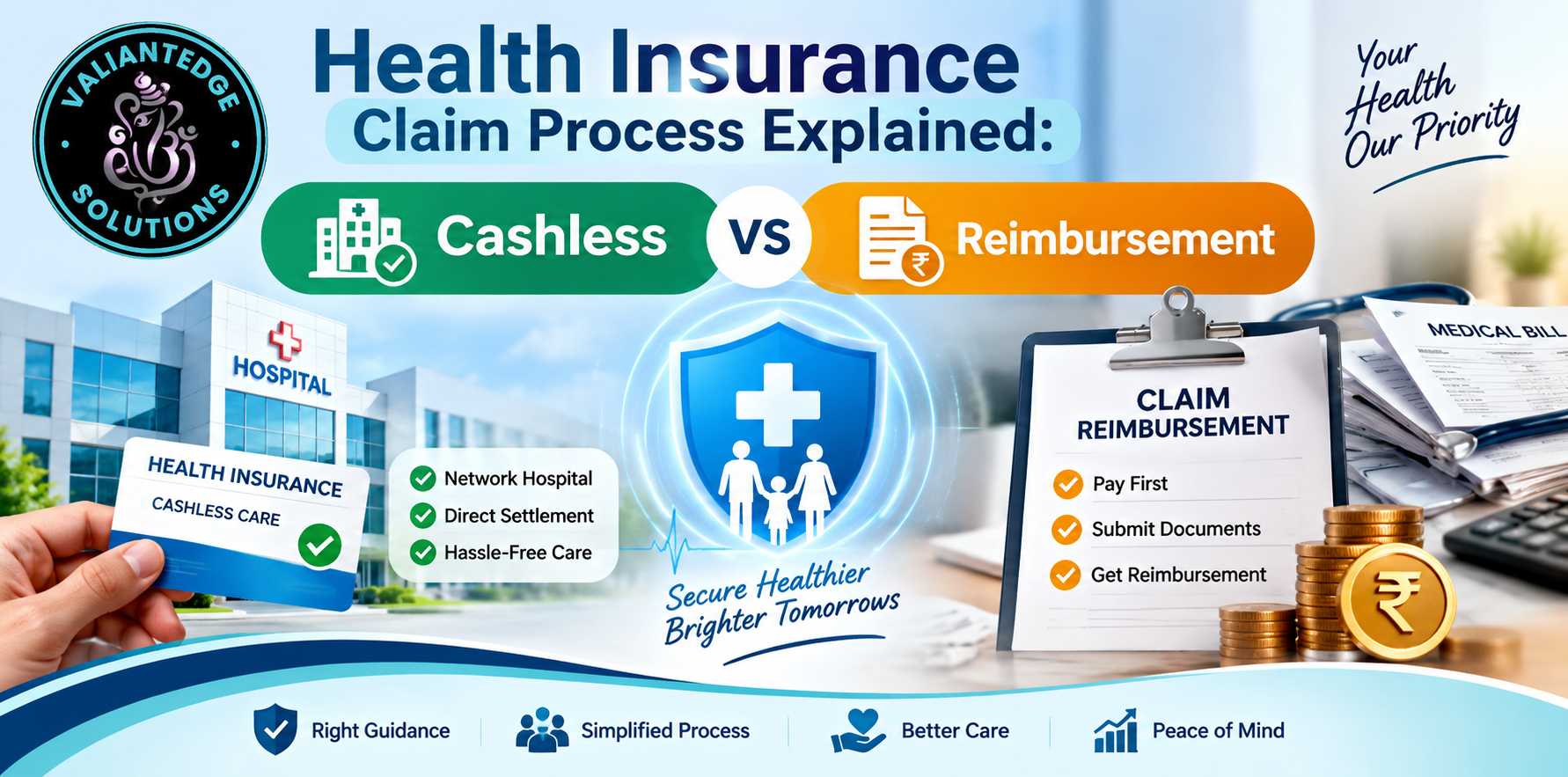
Buying health insurance is only half the job. The other half — the half that actually matters at 2 a.m. outside an emergency ward — is knowing how the health insurance claim process works. Families that understand cashless authorisation, reimbursement paperwork and the common rejection triggers get their claims settled in hours, not weeks.
This is the complete, practical guide our claims desk wishes every policyholder had read in advance: both claim routes step by step, the documents checklist, timelines, what to do when a claim is delayed or rejected, and the habits that make you a “clean claim” customer insurers settle fast.
The Two Claim Routes at a Glance
| Cashless Claim | Reimbursement Claim | |
|---|---|---|
| Where | Network hospitals only | Any registered hospital |
| Who pays the hospital | Insurer (directly) | You pay first, insurer repays |
| Cash needed upfront | Minimal (deposits, non-payables) | Full bill amount |
| Paperwork burden | Hospital’s insurance desk handles most | Entirely on you |
| Typical timeline | Authorisation in 1–6 hours | Settlement in 7–30 days |
Route 1: The Cashless Claim, Step by Step
Planned hospitalisation (surgery scheduled in advance)
- Confirm the hospital is in-network. Check the insurer/TPA app or call the helpline. Networks change — verify even if the hospital was listed last year.
- Intimate the insurer 48–72 hours before admission. Most policies require pre-intimation for planned procedures; skipping it can complicate the claim.
- Submit the pre-authorisation form. The hospital’s TPA/insurance desk sends your policy details, diagnosis and estimated cost to the insurer.
- Receive authorisation. The insurer approves an initial amount (enhancements follow during treatment as costs firm up).
- Get treated; pay only excluded items. Consumables, attendant charges and anything outside policy terms are collected from you at discharge.
- Sign the final bill and keep copies. Even in cashless claims, keep the discharge summary and final bill — you will need them for any super top-up claim on a second insurer.
Emergency hospitalisation
- Admit first, inform fast. Get the patient treated. Notify the insurer/TPA within the window stated in your policy — usually 24 hours of emergency admission.
- Start cashless from the ward. The insurance desk can raise pre-auth after admission; approvals for genuine emergencies typically arrive within hours.
- If authorisation is slow, don’t panic. You can pay deposits and convert the claim to reimbursement later — treatment should never wait for paperwork.
Route 2: The Reimbursement Claim, Step by Step
- Intimate the insurer within 24–48 hours of admission (check your policy’s exact window).
- Collect every original document during the stay (see checklist below). Originals — not photocopies — are mandatory for the primary claim.
- Pay the bill and take a detailed break-up, not just a total. Itemised bills prevent avoidable deductions.
- File the claim within the deadline — usually 15–30 days from discharge. Submit the claim form (signed), documents and cancelled cheque/NEFT details.
- Respond to queries quickly. Insurers pause the clock when they raise a query; slow replies are the top cause of “delayed” settlements.
- Track to closure. Once approved, money lands by NEFT typically within 7 working days. IRDAI rules require insurers to settle or reject with reasons within prescribed timelines — and to pay interest on unjustified delays.
The Complete Documents Checklist
- Claim form (Part A by you, Part B by hospital), signed
- Original final bill with itemised break-up + payment receipts
- Discharge summary (original)
- All investigation reports (blood, imaging, biopsy) with prescriptions advising them
- Doctor’s consultation notes / admission advice
- Pharmacy bills with prescriptions
- Implant stickers/invoice (for stents, lenses, prosthetics)
- KYC of the claimant + cancelled cheque
- FIR / MLC copy for accident cases
- Policy copy / health card
Pro tip: Photograph every document the day you receive it and keep a cloud folder per hospitalisation. If originals go to the primary insurer, attested copies + the primary settlement letter support your super top-up claim.
What Gets Deducted Even From Approved Claims
Understanding “non-payables” prevents billing-counter shocks:
- Consumables: gloves, syringes, dressing kits — excluded unless you bought a consumables add-on.
- Proportionate deduction: if you exceeded your room-rent limit, the whole bill shrinks proportionately.
- Registration/admission charges, attendant food, toiletries.
- Co-pay where the policy carries one.
- Sub-limit overruns on capped procedures.
Why Claims Get Rejected — and How to Avoid Every Reason
- Non-disclosure of pre-existing disease. The number-one cause. Fix: disclose everything at purchase, however minor it seems.
- Claim within a waiting period. Fix: know your 30-day, 2–4 year PED and procedure-specific waiting periods before planning treatment.
- Policy lapsed at renewal. Fix: auto-debit, and use the grace period immediately if a payment bounces.
- Late intimation or late filing. Fix: diarise the windows; intimate by phone and email for a paper trail.
- Treatment not medically necessary / experimental. Fix: get the treating doctor to document medical necessity explicitly.
- Exclusion applies (cosmetic, self-inflicted, substance-related). Fix: read the exclusion list once a year.
- Document gaps. Fix: the checklist above, plus itemised bills.
Claim Rejected or Short-Paid? Your Escalation Ladder
- Ask for the rejection in writing with specific policy clauses cited. Vague rejections often collapse when challenged.
- File a written appeal with the insurer’s Grievance Redressal Officer, attaching supporting medical opinions. Insurers must respond within the regulatory window.
- Escalate to the Bima Bharosa (IRDAI grievance) portal if unresolved — this alone changes many outcomes.
- Approach the Insurance Ombudsman for claims up to the prescribed monetary limit — free, lawyer-less and binding on the insurer.
- Consumer forum / courts as the final step.
Most disputes are won or lost on documentation. This is also where a good advisor earns their keep — our claims desk drafts appeals and handles the entire ladder for clients at no charge.
Special Situations Worth Knowing
Two policies (e.g., corporate + personal)
You may claim from either or split across both under the contribution rules. Common strategy: exhaust the corporate policy first to protect your personal policy’s no-claim bonus.
Base policy + super top-up
Claim the base policy first, then submit the settlement letter with attested documents to the top-up insurer for the amount above the deductible.
Day-care and home care
Procedures under 24 hours (cataract, chemo cycles, dialysis) and, in many modern plans, doctor-advised home treatment are claimable — same document discipline applies.
Accident cases
An MLC (medico-legal case) entry or FIR copy is usually mandatory. Alcohol involvement noted in hospital records typically voids the claim.
Habits of Policyholders Whose Claims Sail Through
- They keep a one-page “insurance card” at home: insurer, TPA, policy numbers, helplines, network-hospital app — and the family knows where it is.
- They intimate early, in writing, every single time.
- They collect itemised bills and photograph everything.
- They disclose fully at purchase and at every renewal upgrade.
- They never let the policy lapse.
Frequently Asked Questions
How long does cashless approval take?
Initial authorisation for emergencies commonly arrives within 1–6 hours; planned pre-auths are often approved a day before admission. Discharge approval can add a few hours — ask the ward to file it early morning.
Can a cashless claim be denied but reimbursement approved?
Yes. Cashless denial only means the insurer would not pre-commit; you can pay, file for reimbursement with full documents, and frequently succeed.
What if the hospital is not in the network?
Treatment proceeds normally; you pay and claim reimbursement. For planned procedures, choosing a network hospital first saves you the float.
Do claims affect next year’s premium?
Health premiums in India are age-banded, not claims-rated for individuals — but a claim can pause or reduce your no-claim bonus depending on plan rules.
Is there a deadline to file reimbursement?
Usually 15–30 days from discharge. File even if late with a written explanation — genuine delays are often condoned, and regulators frown on rejections made purely on technical delay.
Inside the Approval Room: How Insurers Evaluate a Claim
Understanding what the claims processor checks makes your submissions bulletproof. Every claim passes four gates:
- Policy validity: was the policy in force on the admission date, premiums paid, member covered?
- Coverage check: is the diagnosis and treatment covered — outside waiting periods, not excluded, medically necessary, within sub-limits?
- Tariff and reasonableness: are the billed amounts consistent with the hospital’s agreed tariffs (network) or customary charges (non-network)? Inflated or unbundled billing triggers deductions and queries.
- Fraud screens: mismatched dates, template-identical documents, admissions primarily for investigations, or hospitalisation that could have been day-care attract scrutiny — and honest claimants occasionally get caught in these filters, which is why complete, consistent paperwork matters.
Timeline Map: Who Does What, When
| Moment | You / family | Hospital desk | Insurer / TPA |
|---|---|---|---|
| Admission day | Share health card + ID; intimate insurer | Raise pre-auth (cashless) | Initial authorisation |
| During stay | Collect every report & bill copy | Send enhancement requests as costs grow | Approve enhancements |
| Discharge day | Pay non-payables; sign final bill | Send final bill for approval | Final authorisation (2–6 hrs typical) |
| After discharge | File pre/post-hospitalisation expenses | — | Settle within regulatory timelines |
The single best discharge-day tip: ask the ward to send the final bill to the TPA early in the morning. Bills sent at 5 p.m. are why families wait in lobbies until 10 p.m.
Pre- and Post-Hospitalisation Claims: The Forgotten Money
Most policies cover expenses 30–60 days before admission (consultations, diagnostics that led to hospitalisation) and 60–180 days after (medicines, physiotherapy, follow-up scans). Families routinely forget to claim these because they are filed separately after the main claim settles. Keep a dedicated envelope/folder from the first symptom onwards; on a ₹3 lakh surgery, pre/post claims often add ₹30,000–60,000 of legitimate reimbursement.
Real Scenarios and How They Resolve
Scenario 1: Cashless denied for “insufficient information”
The pre-auth cited a vague diagnosis. Fix: have the treating doctor write a specific clinical note (history, findings, ICD code, plan). Resubmitted pre-auths with tight clinical notes are approved far more often. If time-critical, proceed with treatment and convert to reimbursement.
Scenario 2: Proportionate deduction shock
A ₹2.4 lakh bill settled at ₹1.7 lakh because the family took a ₹12,000 room against an ₹8,000 eligibility. Everything scaled down by a third. Fix for next time: confirm room eligibility at admission, in writing, and choose accordingly — or hold a plan with no room cap.
Scenario 3: Two insurers, one big bill
A ₹9 lakh cardiac bill against a ₹5 lakh corporate policy and a ₹10 lakh personal policy. Route: cashless from the corporate insurer up to ₹5 lakh; reimbursement of the balance from the personal insurer using attested copies plus the first insurer’s settlement certificate. Sequence and paperwork were agreed before discharge, so nothing was paid twice or missed.
Scenario 4: Claim rejected as “pre-existing, not disclosed”
The insurer found an old prescription for hypertension predating the policy. Where disclosure genuinely happened (proposal copy showed BP declared), an appeal with the proposal form won. Where it had not, settlement was refused — and legally stood. Moral: your protection against this scenario is built entirely on purchase-day honesty.
Your Rights as a Policyholder
- Written reasons: a rejection or deduction must cite specific policy clauses.
- Time-bound settlement: insurers must decide claims within regulatory timelines after final documents, and pay interest on delayed settlements.
- No arbitrary repudiation after moratorium: once a policy has run for the prescribed continuous period (currently five years), claims cannot be rejected for non-disclosure except in cases of established fraud.
- Portability: you can leave an insurer that treats you badly without losing served waiting periods.
- Free grievance machinery: GRO → Bima Bharosa → Ombudsman costs nothing and does not need a lawyer.
A Family Preparedness Drill (Do This Sunday)
- Create one shared note: insurer names, policy numbers, TPA helplines, health-card photos, agent/advisor number.
- Install the insurer/TPA app on two phones; log in once so it works when needed.
- Shortlist your three go-to network hospitals for emergencies and confirm they are currently in-network.
- Tell every adult where the folder lives — a claim your family cannot find is a claim never filed.
- Set a renewal auto-pay and a calendar reminder a week before.
Fifteen minutes of preparation converts a future 2 a.m. crisis into a process your family already knows how to run.
Hospital Billing Literacy: Reading the Bill Like an Auditor
A surprising number of claim deductions trace back to how hospitals bill, not how insurers pay. Learn these five line-item patterns:
- Package vs itemised billing: network hospitals often have agreed package rates for common procedures. If your bill is itemised far above the package for the same procedure, the insurer pays the package and the difference becomes a dispute. Ask at admission whether your procedure is packaged.
- Room category coding: "deluxe" vs "single AC" naming differs by hospital; what matters is the rent number against your eligibility. Get the room rent stated in writing at admission.
- Doctor visit multiplicity: multiple specialists billing daily visits inflates bills fast; insurers may trim visits not justified in case notes. Ask the treating doctor to document why each consult was needed.
- Pharmacy timing: medicines billed after discharge time, or for take-home use, move from hospitalisation to post-hospitalisation claims. Keep them separated to avoid rejection of the whole pharmacy line.
- Implant invoices: stents, lenses and prosthetics must carry their own invoice and sticker; a lump-sum implant line without these is the most common single deduction in surgical claims.
State of Mind at the Counter: A Script That Works
When the discharge desk quotes a large "patient payable" figure, do not argue medicine; audit process. Ask, in order: "Which items are non-payable and under which policy clause?" (they must map each), "Was the final bill sent for enhancement approval?" (often it was not), and "Can the TPA helpline confirm this deduction while I wait?" (call it on speaker). A calm, clause-based conversation resolves most inflated payable figures within the hour. Anything genuinely disputed can be paid under protest and claimed as reimbursement with a covering letter, preserving your rights without holding the patient hostage at the counter.
Documentation Templates You Can Copy
Intimation email (send within 24 hours)
Subject: Claim intimation - Policy [number] - [Patient name]. Body: patient name and relationship, policy and member ID, hospital name and city, date and time of admission, provisional diagnosis, treating doctor, expected stay, contact number. Request: claim/intimation reference number by return email.
Query response cover note
Reference the claim number, list each query verbatim, answer beneath it, index the attachments, and end with "all documents submitted; please confirm the claim is complete for processing." This one habit prevents the loop where each reply spawns a new query.
Appeal letter skeleton
Facts (dates, amounts), the rejection reason quoted verbatim, your rebuttal mapped to policy clauses, supporting doctor's certificate, relief sought, and a line noting escalation to the Ombudsman if unresolved in 30 days. Attach everything; assume the reader has no file in front of them.
Frequently Asked Follow-ups
Can the hospital refuse cashless even when the insurer approves?
Yes, if the hospital has billing disputes with that insurer or your deposit policy requires it. You can still claim reimbursement; choose a different network hospital next time.
Who owns the original documents after a reimbursement claim?
The insurer retains originals for settled claims. Take attested copies beforehand for any top-up claim, tax records or future reference.
Is ambulance cost covered?
Most policies cover ambulance charges up to a per-claim cap; air ambulance only if specifically included. Keep the receipt with the main bill.
What about organ donor expenses?
Many modern policies cover the donor's hospitalisation for organ harvesting when the recipient is insured; the donor's complications afterwards are usually excluded. Read the specific clause before a transplant.
My claim was approved but the hospital wants the shortfall in cash at midnight. Options?
Pay under protest with a signed itemised bill, or ask the TPA's escalation desk for an immediate re-look; both routes preserve recovery. Never sign a discharge-against-medical-advice form under billing pressure - it can taint the claim itself.
One-Page Claim Cheat Sheet (Print This)
- Emergency admission: treat first, intimate within 24h, start cashless from the ward, keep every paper.
- Planned admission: confirm network + room eligibility in writing, pre-auth 72h ahead, send final bill early on discharge morning.
- Reimbursement: originals only, itemised bills, file within 15-30 days, answer queries same week.
- Deduction dispute: demand clause-wise mapping, pay under protest if needed, appeal in writing.
- Rejection: GRO appeal, then Bima Bharosa, then Ombudsman - free at every step.
- Always: photograph documents, keep pre/post-hospitalisation receipts, never let the policy lapse.
Ten lines on the fridge outperform an hour of panic at the billing counter. Add your policy numbers and helplines beneath them and your family holds a complete claims playbook.
The Bottom Line
A health insurance claim is a process, not a lottery. Choose network hospitals when you can, intimate early, document everything, and know the escalation ladder for the rare dispute. Do these four things and the policy you pay for every year will do exactly what it promised — protect your savings when your family needs care.
Facing a claim right now? Call our claims desk — we guide policyholders through cashless authorisations, reimbursement filings and appeals end-to-end, free of charge.