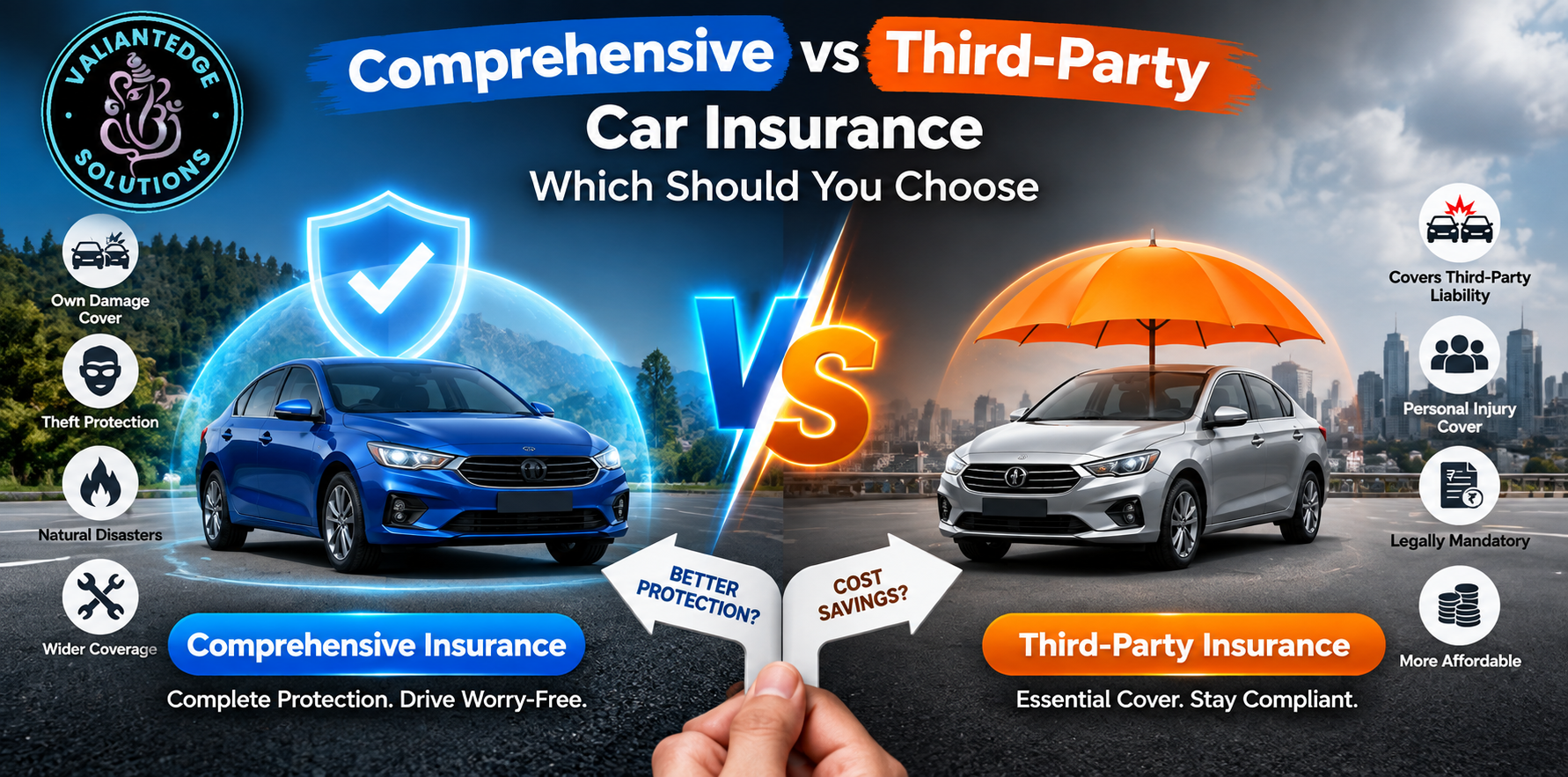
Every car and bike owner in India faces the same fork in the road at policy time: comprehensive insurance or third-party only? One is the legal minimum; the other costs more but covers your own vehicle. The right answer depends on your vehicle’s value, age, where you drive and park, and how much risk you can absorb from your own pocket.
This guide breaks the decision down with a full comparison table, real premium examples, the exclusions of each cover, and a simple decision framework our advisors use with clients every day.
First, the Law
Under the Motor Vehicles Act, third-party insurance is mandatory for every vehicle on Indian roads. Driving without it invites fines (which escalate on repeat offence), possible licence suspension, and — far more seriously — unlimited personal liability if you injure someone or damage their property. Comprehensive cover is optional; the own-damage portion is a choice you make for your own asset.
What Each Policy Actually Covers
Third-party (TP) policy
- Death or bodily injury to a third person — unlimited liability as awarded by tribunals
- Damage to third-party property (up to ₹7.5 lakh for cars)
- Mandatory Personal Accident cover of ₹15 lakh for the owner-driver (bought alongside)
What it pays for your car: nothing. Theft, fire, flood, accident damage to your own vehicle — all yours to bear.
Comprehensive policy
Everything in TP, plus own-damage cover:
- Accident damage to your vehicle (collision, overturning)
- Theft and attempted-theft damage
- Fire, explosion, self-ignition
- Natural calamities: flood, cyclone, earthquake, landslide, hailstorm
- Man-made perils: riots, strikes, vandalism
- Damage in transit (rail/road/inland waterway)
- Optional add-ons: zero depreciation, engine protection, return-to-invoice, roadside assistance and more
Side-by-Side Comparison
| Factor | Third-Party Only | Comprehensive |
|---|---|---|
| Legal compliance | Yes | Yes |
| Other people’s injury/property | Covered | Covered |
| Your car — accident damage | Not covered | Covered |
| Theft of your car | Not covered | Covered |
| Flood / fire / calamity | Not covered | Covered |
| Add-ons available | No | Yes |
| No Claim Bonus | Not applicable | 20–50% own-damage discount |
| Premium (typical hatchback) | ₹3,000–7,500/yr (tariff-set) | ₹8,000–15,000/yr (market-priced) |
| Best for | Very old / low-value vehicles | Almost everything else |
Note the pricing structures differ fundamentally: TP premiums are set by regulation (by engine/vehicle class), while the own-damage portion of comprehensive cover is competitively priced — which is why comparison shopping moves comprehensive premiums a lot and TP premiums not at all.
The Real Cost Difference Is Smaller Than It Looks
Take a 4-year-old mid-size hatchback with an IDV of ₹4 lakh. Third-party alone might cost ₹3,500; comprehensive with a 35% NCB might come to ₹7,500. The ₹4,000 difference buys protection on a ₹4,00,000 asset — a 1% rate for cover against theft, flood and collision. One bumper-and-fender repair at an authorised garage (₹25,000–40,000) exceeds a decade of that difference.
When Third-Party Only Makes Sense
- The car’s market value is very low (roughly under ₹1–1.5 lakh) and you could absorb its total loss without pain.
- The vehicle barely runs — a spare car used a few hundred kilometres a year, parked in a secure private garage.
- You plan to scrap or sell within months and only need legal compliance in the interim.
Even then, remember what you are giving up: an uninsured flood night or a stolen car yields exactly zero.
When Comprehensive Is Clearly Right
- New or financed vehicles — lenders require comprehensive cover, and the early-years value at risk is highest.
- Cars up to 8–10 years old with meaningful resale value.
- Metro parking on public streets — theft, vandalism and scrape risk all rise.
- Flood-prone cities — monsoon claims (hydrostatic engine lock, cabin flooding) are among the largest own-damage payouts; pair comprehensive with an engine-protection add-on.
- Daily commuting in dense traffic — frequency of small-to-medium damage is simply higher.
- Two-wheelers of value — bike theft rates make comprehensive + anti-theft sensible for anything beyond a commuter moped’s residual value.
What Neither Policy Covers
- Driving without a valid licence, or under the influence of alcohol/drugs
- Use outside policy terms (private car used commercially)
- Mechanical/electrical breakdown and normal wear and tear
- Depreciation deductions (unless you hold a zero-dep add-on)
- Consequential damage — e.g., cranking a flooded engine (engine-protect add-on covers this)
- War, nuclear risks; contractual liabilities
- Damage when the policy had lapsed — even by a day
Own-Damage-Only Policies: The Third Option
Since September 2018, new cars come with long-term third-party cover (3 years for cars, 5 for bikes). If your TP is still running but the bundled own-damage year has ended, you buy a standalone own-damage (SAOD) policy — effectively assembling comprehensive cover from two parts, and you can pick different insurers for each. At renewal, compare SAOD quotes exactly as you would comprehensive ones: same IDV, same add-ons.
Decision Framework: 30 Seconds
- Could you comfortably write off the car’s full value tomorrow? No → comprehensive. Yes → continue.
- Is the car worth more than ~₹1.5 lakh, or financed, or street-parked, or in a flood-prone city? Any yes → comprehensive.
- All noes? Third-party only is defensible — revisit annually.
Frequently Asked Questions
Can I upgrade from third-party to comprehensive mid-year?
Yes, subject to a vehicle inspection and the insurer’s acceptance. Easier: upgrade at renewal.
Does comprehensive cover my own injuries?
Your injuries are covered by the mandatory Personal Accident (owner-driver) cover of ₹15 lakh; passengers need the optional passenger PA add-on. Medical expenses beyond that belong to your health policy.
Is NCB available on third-party policies?
No — NCB discounts apply only to the own-damage portion, so pure TP policies neither earn nor use NCB.
My 12-year-old car’s comprehensive quote is almost equal to its IDV benefit — what now?
When annual comprehensive premium approaches 8–10% of a low IDV, TP-only becomes rational. Alternatively, keep comprehensive but drop add-ons and raise the voluntary deductible.
Which is better for a new bike?
Five-year TP is mandatory at purchase; add own-damage cover (bundled or standalone) for at least the first 3–5 years while the bike’s value justifies it.
The Economics Behind the Two Prices
Third-party premiums are fixed by regulation for entire vehicle classes, because TP claims (injury liability) have little to do with which insurer you chose and everything to do with tribunal awards. Own-damage pricing, by contrast, is a competitive market: insurers price your exact model-year, city and claims history. Two consequences for buyers:
- Shopping only moves the OD half. If a comprehensive quote looks dramatically cheap, the discount lives in own-damage pricing or a lowered IDV — check which.
- TP inflation is policy-driven. When tariff revisions raise TP rates, every insurer’s price moves together; that is not your insurer being greedy.
Depreciation Math: What a Standard Comprehensive Claim Really Pays
Without a zero-depreciation add-on, claims deduct depreciation on replaced parts at standard rates:
| Component | Depreciation applied |
|---|---|
| Rubber, nylon, plastic parts, tyres, tubes, batteries | 50% |
| Fibreglass components | 30% |
| Wooden parts | Age-based (5%/yr style) |
| Metal parts | Age-of-vehicle slab (nil to 50%) |
On a modern car — where bumpers, lights, and trim are plastic — a ₹60,000 repair can settle at ₹38,000–45,000 after depreciation and deductibles. This is the gap zero-dep closes, and why it is the most-bought add-on in the country for newer cars.
Total Loss, Theft and the IDV Moment of Truth
When repair costs exceed 75% of IDV (total loss) or the car is stolen and not recovered, the settlement is the IDV (or invoice value with a return-to-invoice add-on). This is when an honestly set IDV proves its worth — and when three pieces of paperwork decide timelines: both original keys (theft claims), the FIR and final untraced report, and RC transfer formalities to the insurer. Expect theft settlements to take longer than accident claims because of the mandatory police process.
City Risk Profiles: Let Geography Inform the Choice
- Flood-prone metros (low-lying localities of Mumbai, Chennai, Gurugram, parts of Delhi NCR and Bengaluru): comprehensive + engine protect + consumables is the monsoon survival kit.
- High-theft zones: comprehensive with anti-theft device; for bikes, gear locks and insurer-approved alarms earn discounts and reduce risk.
- Hill regions: landslide and rockfall damage are natural-calamity claims — comprehensive territory entirely.
- Small towns with light traffic and secure parking: the honest case where an ageing car’s TP-only decision is most defensible.
Five-Year Cost Simulations
Simulation 1: New sedan (₹12 lakh on-road)
Comprehensive with zero-dep averages ~₹35,000/year early on. One moderate accident in five years (₹80,000 repair) settles near-fully. TP-only would have saved ~₹1.2 lakh of premium and then paid ₹80,000 from pocket — plus carried five years of theft/flood exposure on a ₹10+ lakh asset. Comprehensive wins on any realistic risk weighting.
Simulation 2: Seven-year-old hatchback (IDV ₹2.2 lakh)
Comprehensive ~₹9,500; TP-only ~₹3,200. The ₹6,300 difference insures ₹2.2 lakh of asset plus repair risk — still favourable, but now worth tuning: drop zero-dep, take a ₹2,500 voluntary deductible, and the gap narrows to ₹4,000–4,500 for solid protection.
Simulation 3: Thirteen-year-old runabout (IDV ₹70,000)
Comprehensive ~₹6,000 vs TP ~₹3,000 — the premium is nearly 9% of IDV, claims will fight depreciation at every line, and a single deductible eats a large slice of any payout. TP-only (or scrappage planning) is the rational endgame.
Switching Between the Two: Practicalities
- TP-only → comprehensive: possible anytime with inspection; insurers are cautious because people upgrade after damage. Photos, a clean inspection and a break-free TP history smooth it.
- Comprehensive → TP-only: instant at renewal; your accumulated NCB goes dormant (usable within 3 years if you return to own-damage cover — keep the renewal notice as proof).
- Mid-term insurer switch: generally at renewal only; mid-term cancellations refund on a short-period scale and rarely pay off.
Checklist: Questions That Settle the Choice in One Evening
- What would a total loss cost me tonight, after the insurer’s IDV payout of zero (TP) vs full (comprehensive)?
- What did my last two years of small repairs cost — and would depreciation-hit claims have covered them anyway?
- Where does the car sleep — gated garage or public street?
- Does my city flood, and is my parking below road level?
- Is the car financed (comprehensive is then mandatory)?
- Is my NCB above 35% — and therefore worth protecting with the add-on rather than downgrading cover?
Write the answers down once a year at renewal; the right policy type usually names itself.
What the Claims Data Teaches About This Choice
Industry claims patterns hold three lessons for buyers. First, own-damage claim frequency clusters in cities and monsoon months - meaning urban, street-parked cars are precisely the ones that need comprehensive cover, whatever their age. Second, theft is heavily concentrated by model and locality; if your car's model appears in the frequently-stolen lists insurers maintain, the theft component of comprehensive is worth more to you than the average buyer. Third, third-party injury awards from tribunals have risen steadily for years - which is exactly why TP cover is mandatory and why driving uninsured is a wealth-destroying gamble regardless of your car's value. The rational buyer reads these patterns against their own situation rather than pricing alone.
Add-on Fit by Vehicle Age (Comprehensive Buyers)
| Vehicle age | Strongly consider | Usually skip |
|---|---|---|
| 0-3 years | Zero-dep, return-to-invoice, engine protect (flood cities), RSA | - |
| 4-7 years | Zero-dep (if insurer allows), engine protect, NCB protect at high slabs | Return-to-invoice |
| 8-10 years | RSA, consumables | Zero-dep (loading outweighs benefit), RTI |
| 10+ years | Voluntary deductible to trim premium | Most add-ons; reassess comprehensive itself |
Common Misconceptions, Corrected
- "Third-party insurance covers my passengers." Third-party means people outside your vehicle; passengers need the passenger PA add-on, and paid drivers need the legal-liability-to-driver cover.
- "Comprehensive means everything is covered." Exclusions still apply: wear and tear, mechanical failure, drunk driving, invalid licence, use outside policy terms.
- "If my car is old, TP-only is automatically right." Age alone is not the test - a 9-year-old car still worth 3 lakh, street-parked in a flood zone, still argues for comprehensive.
- "Switching to TP-only destroys my NCB forever." It goes dormant, and can usually be revived within three years if you return to own-damage cover with proof.
- "The insurer will find out only if I claim." Misdeclared usage, undeclared CNG, or a false NCB surface exactly at claim time - the worst possible moment to discover a void policy.
Putting the Decision in Writing
Once a year, at renewal, answer the six checklist questions from this guide in a note to yourself: the car's honest market value, where it sleeps, your city's flood and theft picture, loan status, NCB slab and last year's repair spend. Decisions written down beat decisions vaguely remembered - and next year's renewal becomes a five-minute review instead of a fresh research project. If the note ever says "the premium is approaching a tenth of the car's value and I could shrug off its loss", that is your sign the third-party-only endgame has arrived. Until then, comprehensive - correctly tuned - remains the professional's default.
Worked Decision: Three Real Owners
Owner A: 2024 SUV on loan, Gurugram, basement parking
Financed vehicle - comprehensive is mandatory; flood-prone city and basement parking make engine protect essential; zero-dep and return-to-invoice complete the stack. Annual cost is real, but so is the 20-lakh asset and the monsoon.
Owner B: 2018 hatchback, Lucknow, gated society, 50% NCB
Comprehensive continues to win: 2.8 lakh IDV, low premium after NCB, zero-dep dropped this year, small voluntary deductible added. The NCB itself - worth thousands annually - is an asset that TP-only would sideline.
Owner C: 2011 runabout, small town, second car, worth 60,000
The endgame case: premium approaches a tenth of value, claims would fight depreciation line by line. TP-only for legal compliance, savings redirected to the eventual replacement. Reviewed annually in case usage changes.
Three owners, three correct answers - which is the entire point. The comprehensive-vs-third-party choice is a calculation, not a camp; run your own numbers through the checklist each year and let the answer move when your facts do.
The Bottom Line
Third-party cover protects everyone except you. Comprehensive protects your own asset for a difference that is usually a fraction of one repair bill. Unless your vehicle’s value has genuinely fallen below what you would shrug off, comprehensive — tuned with the right IDV, NCB and add-ons — is the answer for most Indian vehicle owners.
Still deciding? Share your vehicle details and city with our advisors — we will price both options across leading insurers, recommend the add-ons that fit your usage, and handle every claim for you afterwards. Free consultation, same-day quotes.