What is health insurance?
Health insurance pays your hospital bills directly to the hospital, up to the sum insured you choose. For an Indian metro family of four, a Rs 10-25 lakh floater typically costs Rs 20,000-45,000 a year and covers room rent, surgery, ICU, pre- and post-hospitalisation and daycare procedures. At Valiantedge Solutions we compare health insurance plans from 25+ IRDAI-licensed insurers, explain the fine print in plain language and stay with you through every renewal and claim.
This guide explains how health insurance works in India in 2026, who should buy it, how much cover is right, what it costs, and the mistakes that cause claims to fail. Everything below is written to answer the questions our advisors hear every day from families and business owners across Delhi, Noida, Ghaziabad, Gurugram, Faridabad and the rest of India.
Health Insurance at a glance
| Feature | Detail |
|---|---|
| Typical family floater cover | Rs 5 lakh to Rs 1 crore |
| Indicative premium, family of four | Rs 20,000-45,000/year for Rs 10-25 lakh in a metro |
| Pre-existing disease waiting | Up to 36 months, reducing across the market |
| Initial waiting period | 30 days, except accidents |
| Specific-illness waiting | Usually 24 months for hernia, cataract, joint replacement and similar |
| Pre/post hospitalisation | Typically 60 days before and 90-180 days after |
| Cashless network | 10,000-15,000+ hospitals, insurer-dependent |
| Tax deduction | Section 80D: Rs 25,000 self/family, extra Rs 50,000 for senior-citizen parents |
| Portability | Allowed at renewal with waiting-period credit carried over |
Who should buy health insurance?
- Families who would otherwise pay hospital bills from savings
- Anyone whose only cover is an employer group policy that ends with the job
- Parents and senior citizens facing rising treatment costs
- People with young children, where paediatric admissions are common
- Self-employed and gig workers with no corporate cover
It is usually not the right first purchase for:
- Realistically nobody; the question is how much cover, not whether
Key benefits of health insurance
Cashless treatment
The insurer settles directly with network hospitals, so you are not arranging money at the admission desk.
Cover far beyond the room bill
Surgeon fees, ICU, diagnostics, daycare procedures, pre- and post-hospitalisation and often domiciliary treatment.
Restoration and no-claim bonus
Many plans restore the full sum insured after a claim and add 10-100% bonus for claim-free years.
Section 80D relief
Up to Rs 75,000-1,00,000 of deduction for a family covering senior-citizen parents.
Protection from medical inflation
Indian medical inflation has run in the low double digits, far above general inflation, which is why a Rs 3 lakh cover bought a decade ago is now inadequate.
How much health insurance cover do you need?
In a metro, a single cardiac or oncology admission in a private hospital can run from Rs 4 lakh to well past Rs 15 lakh. A working rule is at least 50% of annual household income as base cover, with a minimum of Rs 10 lakh for a metro family of four, topped up by a super top-up of Rs 50 lakh or Rs 1 crore, which is remarkably cheap because it only pays above a deductible.
Our advisors run this calculation with you in a 15-minute call, using your actual income, loans, dependants and existing policies, then show side-by-side quotes so the number is grounded in what you will actually pay.
How to buy the right health insurance plan: step by step
- Decide floater or individual. A floater is cheaper for a young family. Once any member crosses 45-50, separate policies often price better and avoid one member exhausting the pool.
- Size the base, then add a super top-up. A Rs 10 lakh base plus a Rs 40-90 lakh super top-up costs far less than a single large policy and covers catastrophic events.
- Check room-rent and co-pay clauses. Room-rent caps silently reduce every other bill head proportionally. We filter for no-capping plans.
- Verify the network near your home. A large national network is useless if the hospital you would actually use is not on it.
- Declare pre-existing conditions. Declared conditions get covered after the waiting period. Undeclared ones get claims rejected.
- Buy before you need it. Waiting periods mean the policy you buy today protects you in 2-4 years for existing conditions. Buying while healthy is the only way to beat them.
Why choose Valiantedge Solutions for health insurance?
Valiantedge Solutions is an insurance advisory and distribution partner serving individuals, families and businesses across India. We are not tied to a single insurer, which means our recommendation for health insurance is based on your profile, not on commission. Every policy we place comes with dedicated claim assistance, renewal reminders and a named advisor you can call.
- Unbiased comparison across 25+ life and general insurers, with IRDAI claim settlement data shown alongside premium.
- Plain-language explanation of waiting periods, exclusions, riders and tax treatment before you sign.
- Claim support that stays with you: we handle documentation and insurer follow-up when you need it most.
- Doorstep, phone or video consultation at a time that suits you, in Hindi or English.
- Transparent pricing: you pay exactly the insurer's premium, nothing extra for advice.
Health Insurance services across India
We help clients buy and manage health insurance in Delhi, Noida, Ghaziabad, Gurugram, Faridabad, Mumbai, Pune, Bengaluru, Hyderabad, Chennai, Kolkata, Ahmedabad, Jaipur, Lucknow and Chandigarh, as well as hundreds of other cities and towns. Local knowledge matters: hospital networks, garage networks, regional claim turnaround and even premium zones vary by city, and our advisors factor that into every recommendation. Use the location pages on this site to find health insurance guidance for your city, or simply request a callback and we will connect you with an advisor who knows your area.
Frequently asked questions about health insurance
How much health insurance is enough for a family of four?
In a metro, start at Rs 10-25 lakh as base cover and add a super top-up of Rs 50 lakh or more. One serious cardiac, cancer or transplant admission in a private hospital can exceed Rs 15 lakh, and medical inflation in India has consistently outpaced general inflation.
Is my employer's health policy enough?
Rarely. Group cover is usually Rs 3-5 lakh, often with co-pay and room caps, it excludes your parents, and it disappears the day you leave the job, typically at the age when buying fresh cover is most expensive.
What is a pre-existing disease waiting period?
It is the period you must hold the policy before conditions you already had are covered, commonly up to 36 months. Portability lets you carry served waiting periods to a new insurer, so switching does not reset the clock.
What does cashless hospitalisation mean?
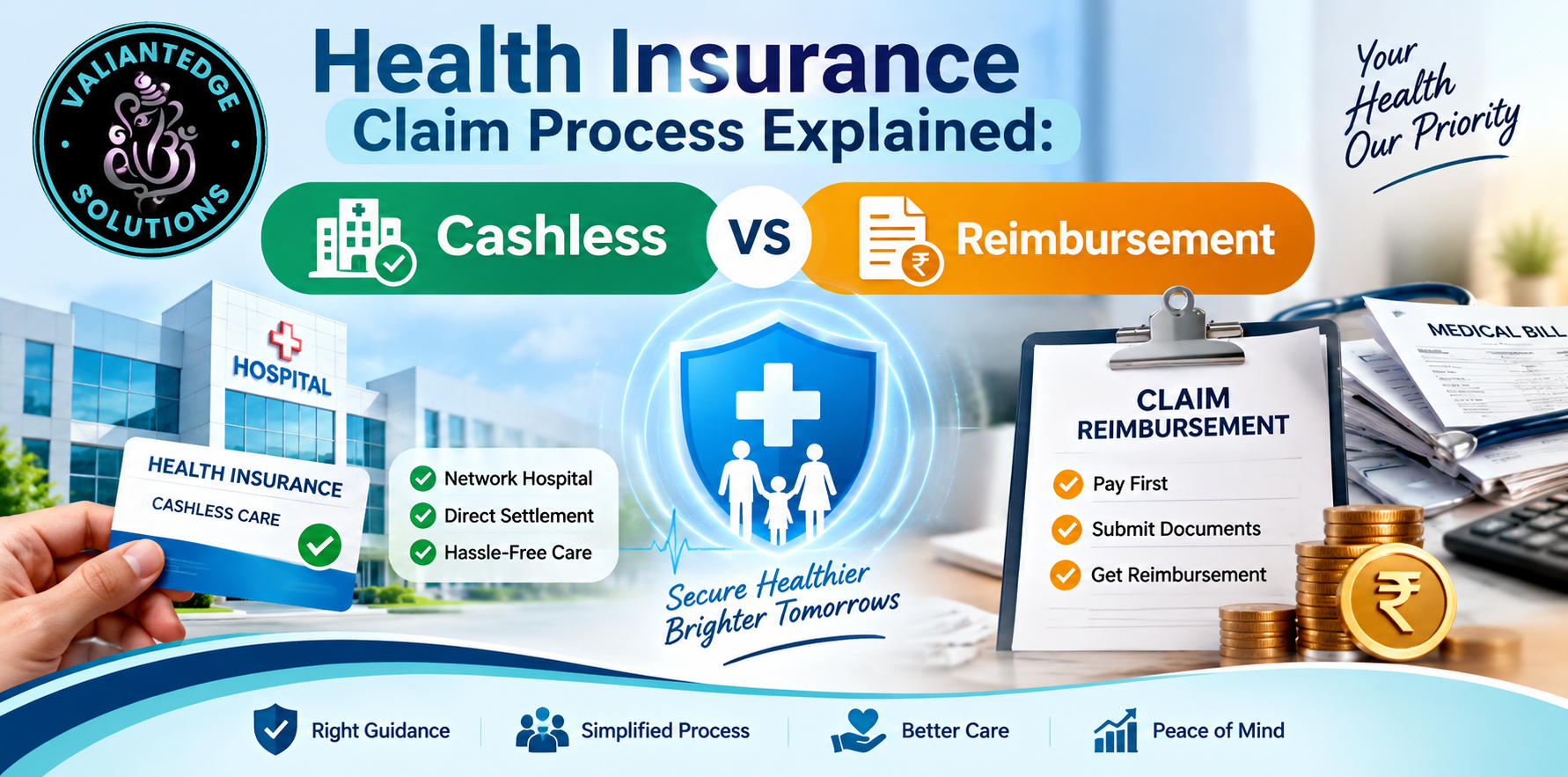
At a network hospital the insurer settles the bill directly. You present your health card, the hospital raises a pre-authorisation, and you pay only non-covered items. Outside the network you pay first and file for reimbursement.
Does health insurance cover maternity?
Only if the plan includes a maternity benefit, and almost always after a waiting period of 24-48 months with a capped amount. It must be planned years in advance.
Can I cover my parents on the same policy?
You can, but a separate senior-citizen policy is usually better: floater premiums are priced on the oldest member, so adding a 65-year-old parent sharply raises the cost for everyone.
What is a super top-up and why is it so cheap?
A super top-up pays only above a chosen deductible, say above Rs 10 lakh of claims in a year. Because the base policy absorbs common small claims, a Rs 50 lakh super top-up can cost a fraction of a Rs 50 lakh base policy.
Get a free health insurance quote today
Share your name and phone number in the form on this page and a Valiantedge Solutions advisor will call you back within one working hour with a personalised comparison. There is no fee, no obligation and no spam. You can also reach us on WhatsApp or call the number at the top of this page.