Car insurance renewal is one of those yearly chores most of us handle in five distracted minutes — usually by clicking “renew” on whatever quote lands in our inbox first. That habit quietly costs Indian car owners thousands of rupees a year and, worse, leaves many driving with cover that no longer matches their car’s value or their needs.
This step-by-step guide shows you how to renew car insurance online the smart way: the documents you need, how to actually compare quotes, the IDV and NCB levers that control your premium, the add-ons worth paying for, and what to do if your policy has already expired.
Why Renewal Is the Best Time to Save
Unlike a new-car purchase — where the dealer usually bundles insurance — renewal is when you hold all the cards. You can switch insurers freely (your No Claim Bonus travels with you), adjust your IDV, drop add-ons you never use, and add ones you have learned you need. Ten minutes of deliberate comparison at renewal routinely saves 20–40% versus auto-renewing the dealer policy.
Before You Start: Keep These Handy
- Current policy copy (any insurer’s portal can also fetch it by vehicle number)
- Registration Certificate (RC)
- Previous claim history (did you claim last year?)
- Odometer reading and current market feel for your car’s value
- Driving licence and PAN/Aadhaar for KYC (now mandatory for policy issuance)
Step-by-Step: Renewing Online
- Start 15–30 days before expiry. Early renewal avoids inspection requirements and last-minute pricing pressure. Set a phone reminder the day your policy month begins.
- Pull 4–5 quotes for identical specs. Same IDV, same add-ons, same deductible — otherwise you are comparing apples to mangoes. Aggregators help, but also check 1–2 insurer sites directly and, for claims-heavy profiles, ask an advisor which insurers are settling smoothly this year.
- Check the IDV, don’t just accept it. Insured Declared Value is your car’s insured worth — the maximum payout on theft or total loss. Insurers can show a low IDV to look cheap. More below.
- Verify your No Claim Bonus. Your NCB discount (20–50%) should carry forward automatically; when switching insurers, the new one verifies it from the old policy. A wrongly declared NCB can void claims, so state it accurately.
- Select add-ons deliberately (see the shortlist below), and remove ones that no longer fit — zero-dep on a 9-year-old car often is not worth it.
- Complete KYC and pay. Policy PDF arrives by email within minutes. Save it to your phone and cloud drive; keep a copy in the car.
- Verify the policy details immediately. Registration number, engine/chassis numbers, NCB, IDV, add-ons, hypothecation (financier name if the car is on loan). Errors are easiest to fix in the first week.
Understanding IDV: The Number That Decides Your Payout
IDV is roughly the manufacturer’s listed price minus age-based depreciation. You can usually adjust it ±15%:
- Lower IDV → cheaper premium, but a smaller cheque if the car is stolen or totalled.
- Higher IDV → slightly costlier premium, bigger protection.
Rule of thumb: set IDV close to your car’s realistic resale value. Saving ₹800 on premium by understating IDV by ₹80,000 is a terrible trade if the car is written off. The IDV game is the most common trick behind “unbelievably cheap” renewal quotes — always compare quotes at the same IDV.
No Claim Bonus: Protect It Like an Asset
| Claim-free years | NCB discount on own-damage premium |
|---|---|
| 1 | 20% |
| 2 | 25% |
| 3 | 35% |
| 4 | 45% |
| 5+ | 50% |
Three things owners often miss: NCB belongs to you, not the car — it transfers to your next car; it survives an insurer switch; and it lapses if you leave a gap of more than 90 days after policy expiry. For small damages (a scratched bumper worth ₹4,000), paying out of pocket usually beats claiming and resetting a 35–50% discount — do the maths before every small claim. An NCB protection add-on lets you make 1–2 claims a year without losing the bonus; if your NCB is at 45–50%, it is frequently worth the price.
Add-ons: The Worth-It Shortlist
- Zero depreciation (bumper-to-bumper): claims paid without deducting parts depreciation. Strongly recommended for cars up to 5–7 years old; typically raises premium 15–20% but changes claim outcomes dramatically.
- Engine protection: covers hydrostatic lock and engine damage from waterlogging — near-essential in flood-prone cities during monsoon.
- Roadside assistance: cheap (₹200–500) and useful — towing, battery jump, flat tyre, fuel delivery.
- Return to invoice: on theft/total loss, pays the invoice price rather than depreciated IDV. Great value in years 1–3.
- Consumables cover: oils, nuts, filters that standard claims exclude.
- Personal accident cover for passengers — the mandatory PA cover applies to the owner-driver; passenger cover is a small, sensible extra for family cars.
Skip what you will not use: tyre protection on highway-rarely cars, key replacement if your insurer prices it high, daily-allowance covers with tight conditions. Every add-on should answer a real risk you face.
Comprehensive, Third-Party or Own-Damage: A 60-Second Refresher
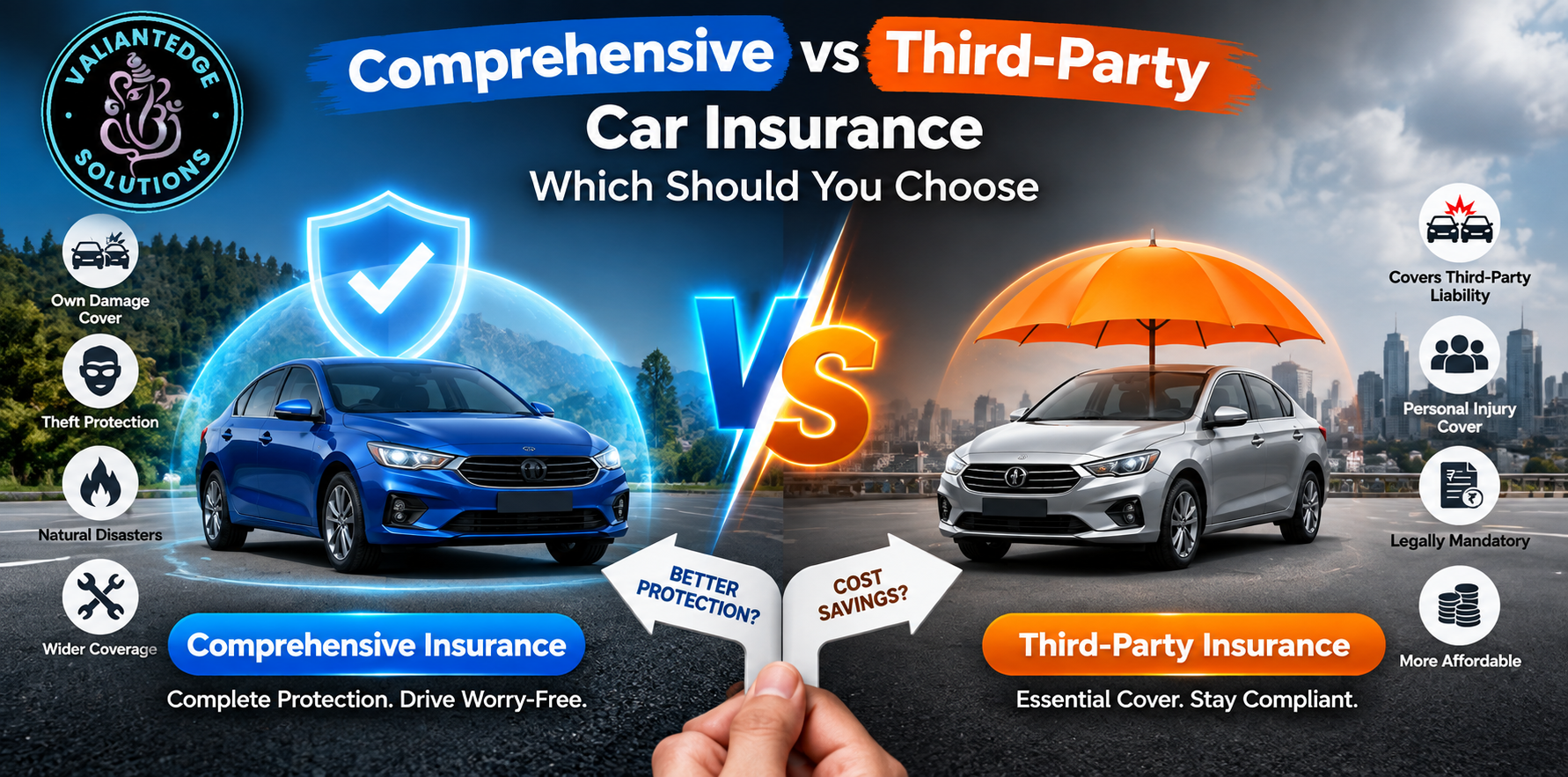
- Third-party only: the legal minimum — covers damage you cause to others; pays nothing for your own car.
- Standalone own-damage: pairs with an existing long-term third-party policy (common for cars bought after Sep 2018).
- Comprehensive: third-party + own damage + theft/fire/natural calamities. The right choice for most cars that are worth repairing.
For an ageing car worth under ₹1–1.5 lakh, third-party-only can be rational; for everything else, comprehensive with the right add-ons is the sensible default. (We compare this decision in depth in our companion guide to comprehensive vs third-party cover.)
Renewing an Expired Policy
- Within the grace window (up to 90 days): your NCB survives, but there is no cover during the gap — do not drive uninsured; renewing online usually reinstates cover the same day. Some insurers require a self-inspection video through their app.
- Beyond 90 days: NCB lapses and the renewal is treated as a fresh policy, often with a vehicle inspection. Expect a pricier premium.
- Driving uninsured risks fines, licence consequences and unlimited personal liability for third-party injury — the one risk no one should carry.
Money-Saving Checklist at Every Renewal
- Compare at identical IDV and add-ons — minimum 4 quotes.
- Confirm NCB is applied at the right slab.
- Consider a modest voluntary deductible if you rarely claim.
- Drop zero-dep past year 7; add engine protect if you park on a flood-prone street.
- Install an ARAI-approved anti-theft device — small additional discount.
- Avoid dealer-quoted renewals without comparison — they are frequently the costliest option.
- Never misdeclare NCB, usage (commercial vs private) or CNG kits — each can void claims.
Frequently Asked Questions
Can I switch insurers at renewal without losing benefits?
Yes — NCB transfers fully. Only continuity-dependent add-ons (like zero-dep on an older car) may need the new insurer’s approval or an inspection.
Is vehicle inspection required for online renewal?
Not if you renew before expiry. Post-expiry renewals and some add-on upgrades may need a physical or app-based self-inspection.
What is a voluntary deductible?
An amount you agree to bear in every claim in exchange for a premium discount. Choose it only at a level you would happily pay from pocket.
Does my policy cover a CNG kit?
Only if declared and endorsed on the RC and policy. Undeclared kits are a common claim-rejection cause.
My car is financed — anything special?
The financier’s hypothecation must appear on the policy, and total-loss payouts route through them until the loan closes.
The Renewal Premium, Deconstructed
Your comprehensive renewal quote is really four line items — and only some respond to shopping:
| Component | Set by | Can you optimise it? |
|---|---|---|
| Third-party premium | Regulated tariff (engine cc / vehicle class) | No — identical everywhere |
| Own-damage premium | Insurer pricing on IDV, age, model, city | Yes — compare, adjust IDV, deductibles |
| Add-ons | Insurer | Yes — choose deliberately |
| PA owner-driver cover | Near-standard pricing | Skip only if already held on another policy |
This is why two “identical” quotes can differ by thousands: one insurer’s own-damage rate for your exact model-year in your city can be far sharper than another’s. Model-level pricing differences are real — insurers with better claims experience on your car’s make often quote it noticeably cheaper.
Making a Claim Without Wrecking Next Year’s Renewal
Renewal strategy and claims strategy are the same subject viewed from two ends:
- Get an estimate before intimating. For visible cosmetic damage, a garage estimate tells you whether the claim beats the NCB loss.
- The break-even maths: claim only if (repair cost − deductibles − depreciation on parts) > (NCB discount you will forfeit next year + the years it takes to rebuild it). At a 50% NCB on a ₹20,000 own-damage premium, a ₹12,000 claim is usually a losing trade.
- Cashless garages: like health networks, insurer-tied garages settle directly; elsewhere you pay and reimburse. Check the network before choosing a body shop.
- Surveyor step: claims above small thresholds get a surveyor inspection; don’t begin repairs before it (photos help, authorisation matters).
- Third-party incidents: never settle injury cases privately at the roadside; TP claims run through tribunals and your insurer’s lawyers — intimate immediately and share the FIR.
Bike and Scooter Renewals: The Differences That Matter
- Five-year TP at purchase means many riders only ever renew own-damage cover — and many let it silently lapse after year one. If the bike is worth repairing, renew the OD component annually.
- Theft weighting: two-wheeler theft claims are proportionally higher; an anti-theft device discount plus accurate garage/parking declaration genuinely matters.
- Helmet-and-gear add-ons exist but read the caps; a ₹1,500 add-on covering ₹5,000 of gear with a 50% depreciation clause rarely earns its keep.
- Pillion PA cover is inexpensive and worth it for families.
Commercial and Special-Use Vehicles
If a vehicle earns money — cab aggregator, delivery, school van — a private policy will not pay its claims. Commercial motor policies differ in TP tariffs, permitted-use clauses, driver-clause requirements and IDV norms. The most expensive mistake in this category is running a “private” car commercially: premiums saved for a year, claims denied for the incident that mattered. Declare usage honestly and price the right policy.
Electric Vehicles: Renewal Notes for EV Owners
- TP discount: electric vehicles enjoy concessional third-party tariff rates.
- Battery is the car: the traction battery can be 40–50% of vehicle value. Ask specifically how the policy treats battery damage from water ingress and charging incidents — and whether a battery-protect add-on exists for your model.
- Charger and cable cover: some insurers extend cover to the home charger and cables; worth a question at renewal.
- IDV curves differ: EV depreciation curves are still settling; compare IDV offers across insurers more aggressively than you would for an ICE vehicle.
Reading the Policy PDF in Four Minutes (Post-Purchase Audit)
- Page 1 schedule: registration, engine, chassis, hypothecation, period of insurance — character-perfect?
- IDV figure: matches what you chose, not a silently lowered number?
- NCB percentage printed: correct slab?
- Add-ons listed by name: each one you paid for present?
- Deductibles: compulsory + any voluntary you opted — as agreed?
Errors reported within days get endorsed free and fast; discovered at claim time, they become disputes.
Myths That Refuse to Die
- “New parts are covered fully anyway.” Without zero-dep, plastic parts commonly attract 50% depreciation deductions.
- “My friend can drive; insurance follows the car.” The policy follows the car, but the driver needs a valid licence and any TP injury he causes still lands on your policy — and your NCB.
- “Small dents later, I’ll claim everything together.” Insurers reject claims mixing unrelated old and new damage; each incident is a separate claim.
- “Engine damage is accident damage.” Hydrostatic lock from cranking a flooded car is consequential damage — excluded without engine-protect.
- “Renewal date is flexible by a few days.” Cover ends at midnight of expiry; the gap is real even if NCB survives 90 days.
A Year in the Life of a Well-Managed Policy
Here is the calendar our best-organised clients follow, adapted to any renewal month:
- T-30 days: pull the current policy PDF; note IDV, NCB, add-ons, deductibles. Photograph the odometer.
- T-21 days: collect four quotes at matched specs; ask your advisor which insurers are settling claims fastest for your car's make this year.
- T-14 days: decide add-on changes (drop, add, keep) based on the past year - did you claim, did the city flood, did the car age past a threshold?
- T-7 days: buy. Verify the policy PDF the same day; report any error immediately for a free endorsement.
- Renewal day: confirm the old policy's end and new policy's start leave no midnight gap.
- During the year: keep the policy PDF and claim helpline in the car and on your phone; after any incident, photograph everything before moving the vehicle if safe.
Reading Between the Lines of "Cheapest" Quotes
When one quote undercuts the market by a wide margin, look for the levers that produced it: an IDV set 10-15% lower than the rest; a compulsory-plus-voluntary deductible quietly raised; zero-dep silently absent while the quote page's fine print says "as selected"; or NCB assumed at a slab you have not actually earned (which becomes your problem at claim time, since a wrong NCB declaration can void the own-damage claim). The two-minute defence: line up all quotes in a table with IDV, deductibles, NCB and each add-on as rows. The "cheap" quote usually reveals itself before you pay, not after.
Claims Etiquette That Speeds Settlements
- Photograph first, move second (when safe): scene, damage close-ups, other vehicle's plate, road context.
- Intimate within 24-48 hours even if unsure about claiming; you can always withdraw a claim, but late intimation invites scrutiny.
- One narrative: the story you tell the insurer, the surveyor and the garage must match. Inconsistencies, however innocent, delay files.
- Keep towing and spot-repair receipts: reasonable protection-and-removal costs are typically payable.
- Don't authorise dismantling before the surveyor unless the insurer's app-based self-survey has cleared it.
Final FAQ Round-up
Can I transfer my policy when I sell the car?
The buyer must transfer the policy (or buy fresh cover) within the prescribed days of RC transfer; you should retain your NCB certificate for your next car. Inform the insurer of the sale in writing to end your liability.
Is my laptop/phone inside the car covered?
No - personal belongings need a specific add-on or home-insurance cover. The car policy covers the car.
Does a windshield claim break my NCB?
Yes, a standard own-damage claim - however small - typically forfeits NCB unless you hold NCB protection. Many owners pay small glass claims out of pocket for exactly this reason.
What if the accident was the other driver's fault?
You may claim under your own-damage cover and let insurers subrogate, or pursue the other party's third-party insurer via tribunal - the first route is faster, and NCB-protected policies make it painless.
Are dealership "insurance packages" at car purchase bad?
Not inherently - but compare. Bundled year-one policies often carry full-price add-ons; you can legally buy insurance from any insurer before delivery, and the dealer must accept it.
Closing Perspective: The Premium Is the Small Number
Across ten years, a typical car owner pays perhaps 1-1.5 lakh in comprehensive premiums and faces, statistically, one or two meaningful claims plus a background risk of theft or total loss worth several lakh. Every technique in this guide - honest IDV, protected NCB, matched-spec comparison, deliberate add-ons, airtight paperwork - exists to make sure the big number arrives when needed, while trimming the small number every year. Renewal is simply the annual moment when both numbers are negotiable. Give it the fifteen minutes it deserves.
The Bottom Line
Treat renewal as an annual 15-minute audit, not a one-click chore: right IDV, verified NCB, deliberately chosen add-ons, and four honest quotes. Do that each year and you will hold cover that actually pays when things go wrong — usually at a lower premium than the auto-renewal you almost clicked.
Renewal due soon? Send us your car’s registration number and current policy — our advisors will return a like-for-like comparison across leading insurers, with claim-experience notes you will not find on aggregator sites. Free, and usually same-day.